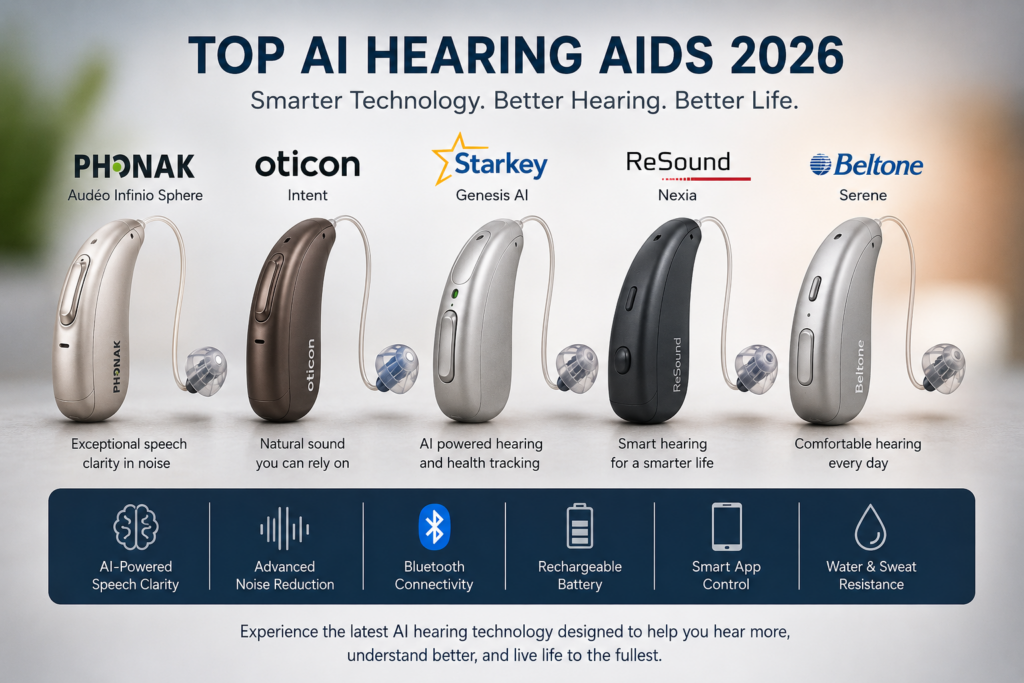
If you are looking to invest in the best AI hearing aids of 2026, you have likely noticed that artificial intelligence has fundamentally transformed modern hearing technology. Today, nearly every premium manufacturer—including Phonak, Oticon, Starkey, ReSound, Beltone, Signia, and Widex—promotes AI-powered capabilities. However, a critical question remains for consumers and clinicians alike: Are all AI hearing aids the same?
The definitive answer is no.
While the term “AI” is used universally across marketing materials, the underlying hardware, software processing philosophies, and machine learning models vary drastically between brands. Furthermore, a premium device is only as effective as the specialized programming behind it. As a local, clinician-owned independent audiology practice serving the Vaughan and Woodbridge communities, we believe that true hearing clarity comes from matching the right algorithmic processing style to your unique auditory anatomy and daily environment—not from a one-size-fits-all corporate solution. How a manufacturer designs and trains its AI directly dictates how effectively that device performs in complex, real-world auditory environments. Understanding the scope of modern AI hearing aids technology is essential before making a purchase.
What Does AI Actually Do inside a Hearing Aid?
In premium hearing technology, artificial intelligence is not a static feature; it is an active, real-time processor. Modern devices analyze the surrounding acoustic landscape thousands of times per second to execute complex adjustments instantaneously.
When properly implemented, advanced AI engines work to:
- Isolate Speech in Noise: Dynamically separating the acoustic characteristics of human speech from chaotic background noise.
- Adapt Environmentally: Smoothly transitioning settings as you move from a quiet car to a loud restaurant without manual programmatic adjustments.
- Manage Transient Sound: Instantly suppressing sudden, jarring impacts (like dropping cutlery) or continuous environmental noise (like wind) without dropping the volume of the conversation you want to hear.
- Enhance Spatial Awareness: Optimizing directional microphone arrays to help the brain identify precisely where a sound originates.
Why AI Hearing Aids Sound Radically Different
If two distinct brands both feature “AI noise reduction,” they will still deliver completely different listening experiences. This variance comes down to four fundamental technological pillars:
1. Distinct Machine Learning Architectures
Manufacturers utilize different tiers of artificial intelligence. Some rely on traditional machine learning algorithms that use predefined rules to classify environments. The most advanced flagships employ onboard Deep Neural Networks (DNN).
A DNN does not follow basic rules; it has been trained on millions of real-world soundscapes to mimic how the human brain naturally prioritizes sound.
2. Processing Power and Chip Infrastructure
An AI algorithm is only as fast as the silicon microchip running it. Premium devices utilize dedicated, high-capacity processors capable of executing billions of operations per second.
- Dual-Chip Architecture: Some manufacturers use a two-chip system—one dedicated strictly to baseline acoustic processing and wireless connectivity, and a second, specialized co-processor built entirely to handle heavy DNN sound isolation. This prevents lag and preserves battery life.
- Edge Computing: Processing sound instantaneously on the ear (on-device edge computing) ensures zero audio delay, whereas relying on a smartphone app to handle data processing can cause minor synchronization lag.
3. Training Data Variables
AI learns through data exposure. Manufacturers train their networks using vastly different sound libraries recorded in restaurants, offices, subway stations, and homes. The depth, diversity, and size of a manufacturer’s acoustic training library directly dictate how accurately the device will recognize and clarify speech in your everyday life.
4. Divergent Manufacturer Processing Philosophies
Every major audiology brand approaches sound processing with a unique clinical philosophy:
- Phonak: Prioritizes maximum speech clarity and separation above all else, especially in extreme, competitive noise environments. Their dual-chip DNN architecture focuses on aggressively stripping away background chaos to bring the primary speaker forward.
- Oticon: Operates on a “BrainHearing” philosophy. Rather than cutting out the environment, Oticon utilizes an always-on DNN alongside user-intent sensors (tracking subtle head and body movements) to organize the full 360∘ sound landscape, allowing the brain to naturally choose what to focus on.
- Starkey: Blends advanced, real-time acoustic adjustments (such as automated on-demand edge processing) with comprehensive health and wellness tracking, featuring integrated fall alerts, activity monitoring, and cognitive wellness metrics.
- ReSound & Beltone: Emphasize organic sound quality, spatial awareness, and strong performance in music appreciation. Their AI focuses on maintaining comfortable, natural spatial cues while preserving reliable direct streaming connectivity.
Choosing the Best AI Technology for Your Lifestyle
Because processing styles vary so dramatically, there is no single “best” AI hearing aid on the market. The ideal instrument must be matched to several unique individual variables:
- The specific configuration and severity of your hearing loss.
- Your daily acoustic demands (e.g., highly active corporate settings vs. quiet, independent home environments).
- Your cognitive listening preferences (e.g., desiring aggressive background noise reduction vs. preferring an open, natural soundscape).
A professional who spends hours in noisy boardrooms or crowded venues requires an entirely different AI processing strategy than someone who primarily seeks exceptional music fidelity or casual, one-on-one conversations.
The Critical Role of Professional Audiological Fitting
The most sophisticated AI engine is fundamentally restricted without precision programming. Hearing aids are medical devices, not consumer earbuds.
An audiologist utilizes diagnostic data—including comprehensive audiometric testing, speech-in-noise testing, and specific ear canal acoustics—to precisely customize the AI’s behavior. Through diagnostic programming software and Real-Ear Verification measurements, the device is calibrated to match your exact physical anatomy and prescriptive targets. Ongoing professional care ensures the AI adapts as your hearing needs evolve over time.
Experience Personalized AI Hearing Aid Technology
Don’t navigate the complex world of hearing technology alone or rely on cookie-cutter corporate recommendations. As an independent, clinician-owned practice, Golden Hearing & Balance Center is dedicated to finding the precise technology that brings clarity back to your life.
Whether you spend your days in bustling social settings or enjoying the quiet comfort of home, our comprehensive clinical evaluations and precise Real-Ear Verification ensure your AI prescription is uniquely calibrated for you.
[Schedule your comprehensive audiatric evaluation at our Vaughan clinic today]
Frequently Asked Questions
Are all AI hearing aids the same?
No. Each manufacturer utilizes proprietary algorithms, distinct microchip processing speeds, different sound training datasets, and unique audiological philosophies, creating distinct differences in sound quality.
Do AI hearing aids need an internet connection to work? How is data processed?
No, AI hearing aids do not require an internet connection, Wi-Fi, or cellular data to process sound. The artificial intelligence is completely self-contained.
Before the hearing aid ever reaches your ear, the manufacturer trains the AI in a laboratory using millions of real-world sound recordings. This collective intelligence is condensed into a tiny, pre-programmed map and loaded directly onto the hearing aid’s internal microchip. When you wear the device, this onboard chip acts as a local processor. It instantly runs the incoming environment through its pre-loaded map, processing and cleaning the sound entirely on the device in real time, with zero dependency on the cloud or external connectivity.
Do my AI hearing aids need monthly or yearly software updates to improve performance?
No, you do not need to update your hearing aids every month or year just to keep them working well. Because the AI is fully integrated onto the local microchip, your devices will consistently perform at the high level they were programmed for from day one.
However, manufacturers do occasionally release periodic firmware updates (typically once or twice a year). Rather than a complete overhaul, these updates generally provide minor stability improvements, patch smartphone Bluetooth bugs, or optimize battery efficiency. When you visit our clinic for your regular check-ups and cleanings, we will automatically check for these updates and install them for you through our clinical programming software to ensure your technology runs smoothly.
Will my AI hearing aids learn my lifestyle over the first month or two, and should I expect my hearing to get better?
Yes—your overall listening experience will change and feel significantly better after one to two months, but it happens due to a combination of your hearing aid’s technology and your own brain.
First, your hearing aid continuously uses Data Logging to track your environments, your daily wearing habits, and any manual volume adjustments you make. When you come back to our clinic for your follow-up, we use this data map to fine-tune the programming specifically to your lifestyle patterns.
Second, the real “learning” happens in your brain. A biological process called auditory acclimatization takes about 4 to 6 weeks. After years of hearing deprivation, your brain’s auditory cortex needs time to build new neural pathways and adjust to the restored sounds. By month two, your brain learns to push steady background sounds into the background naturally, making conversations feel much clearer, smoother, and less exhausting. Consistent, daily wear during this initial period is the key to training your brain and getting the absolute most out of your AI technology.
Does AI completely eliminate background noise?
No. Complete noise elimination would create a highly unnatural, isolating, and potentially unsafe listening experience. Instead, AI is designed to suppress intrusive noise while accentuating speech cues so you can converse comfortably without losing environmental awareness.
Is professional fitting really necessary for AI hearing aids?
Yes. AI requires accurate baseline parameters to function correctly. Without professional diagnostic fitting, prescriptive target programming, and physical verification inside your ear canal, an AI hearing aid cannot accurately calculate or deliver the speech clarity it is capable of providing.