
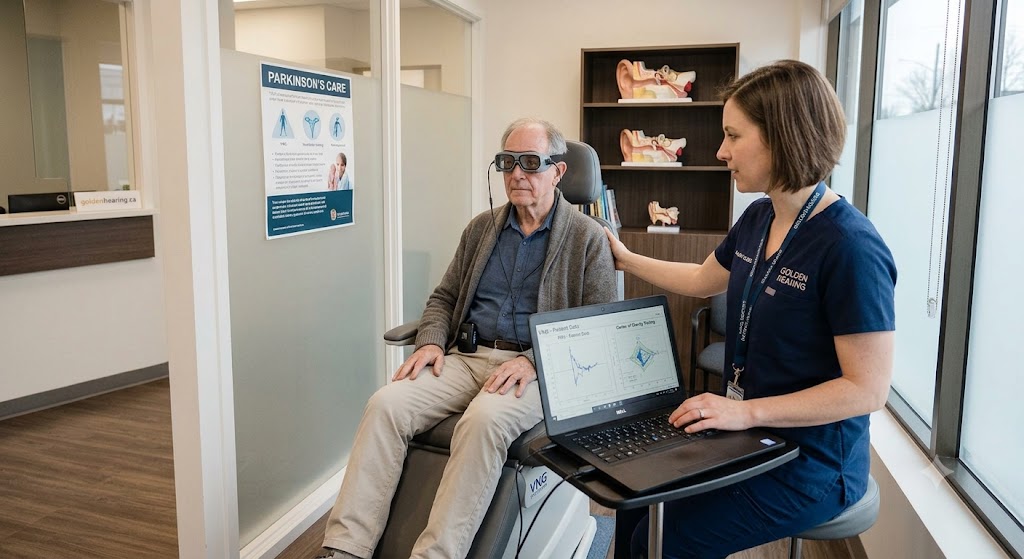
Parkinson’s disease balance testing is an essential part of evaluating dizziness, imbalance, and fall risk in people living with Parkinson’s disease. While Parkinson’s disease is best known for causing tremors, muscle stiffness, slowed movement, and changes in walking, research suggests that the vestibular (inner ear) system may also contribute to balance problems in some individuals. At Golden Hearing and Balance Center, our comprehensive Parkinson’s disease balance testing program uses advanced vestibular technology to determine whether balance difficulties are related to changes in the brain, the inner ear, or a combination of both. Identifying the underlying cause is the first step toward improving mobility, reducing falls, and enhancing quality of life.
Understanding the Inner Ear and Balance
The inner ear contains two closely connected systems:
- The cochlea, responsible for hearing.
- The vestibular system, responsible for detecting head movement and maintaining balance.
These systems constantly communicate with the brain, eyes, muscles, and joints to keep you stable while standing, walking, turning, and changing positions.
Although Parkinson’s disease primarily affects the central nervous system, growing evidence suggests that vestibular dysfunction may also contribute to dizziness, imbalance, and falls. Because some vestibular disorders are treatable, identifying them can make a significant difference in a patient’s daily function.
Why Parkinson’s Disease Balance Testing Matters
Routine neurological examinations do not always evaluate the inner ear in detail. Parkinson’s disease balance testing provides valuable information about vestibular function and helps determine whether dizziness or instability is caused by neurological changes, vestibular dysfunction, or both.
This comprehensive approach helps healthcare providers develop more targeted treatment plans and supports better fall-prevention strategies.
What Research Shows About Parkinson’s Disease and Balance
Recent scientific studies have expanded our understanding of balance disorders in Parkinson’s disease.
Vestibular Dysfunction May Increase Balance Problems
Research suggests that some individuals with Parkinson’s disease have reduced vestibular function compared with healthy adults. These changes may contribute to dizziness, impaired balance, and an increased risk of falls.
Video Head Impulse Testing Detects Subtle Vestibular Deficits
The Video Head Impulse Test (vHIT) evaluates the Vestibulo-Ocular Reflex (VOR), which keeps vision stable during head movement.
Studies suggest that some people with Parkinson’s disease may have reduced VOR function affecting one or more semicircular canals. These subtle abnormalities are not always detected during routine neurological examinations but may contribute to instability, particularly during quick head movements.
Treatable Inner Ear Disorders Can Occur Alongside Parkinson’s Disease
Not every episode of dizziness is caused by Parkinson’s disease itself.
Research has shown that Benign Paroxysmal Positional Vertigo (BPPV) occurs in some people living with Parkinson’s disease. BPPV is caused by displaced calcium crystals within the inner ear and can often be treated successfully using simple repositioning maneuvers performed by trained clinicians.
Identifying BPPV can provide rapid symptom relief and improve balance.
Hearing and Balance Are Closely Connected
Hearing contributes to spatial awareness, communication, and environmental awareness. Because age-related hearing loss commonly occurs alongside Parkinson’s disease, evaluating hearing together with vestibular function provides a more complete picture of balance performance.
Advanced Parkinson’s Disease Balance Testing at Golden Hearing and Balance Center
Our goal is to provide safe, comfortable, and comprehensive vestibular assessments.
Many people with Parkinson’s disease have difficulty standing for extended periods due to rigidity, postural instability, or fear of falling. Whenever clinically appropriate, much of our Parkinson’s disease balance testing can be performed while you remain comfortably seated in a specialized examination chair.
Our comprehensive assessment may include:
Videonystagmography (VNG)
Videonystagmography (VNG) measures how well your inner ear and brain work together by recording involuntary eye movements.
Using lightweight infrared goggles, we evaluate eye movements during visual and positional testing to help determine whether dizziness is related to an inner ear disorder or another neurological condition.
Video Head Impulse Test (vHIT)
The Video Head Impulse Test (vHIT) is one of today’s most advanced vestibular assessments.
While wearing lightweight goggles equipped with a high-speed camera, small and gentle head movements are performed to evaluate the function of all six semicircular canals individually.
This technology allows our audiologists to detect subtle vestibular deficits that may contribute to imbalance and falls.
Comprehensive Hearing Evaluation
Because hearing and balance work together, we also perform a complete hearing assessment when clinically indicated.
Evaluating hearing helps us better understand the overall function of the inner ear and determine whether hearing rehabilitation may improve communication, spatial awareness, and overall quality of life.
Benefits of Parkinson’s Disease Balance Testing
Comprehensive Parkinson’s disease balance testing provides valuable information that can help improve patient care.
Potential benefits include:
- Identifying treatable vestibular disorders such as BPPV.
- Detecting vestibular hypofunction that may benefit from vestibular rehabilitation therapy.
- Providing additional diagnostic information for neurologists and family physicians.
- Distinguishing vestibular disorders from Parkinson’s disease symptoms.
- Supporting individualized fall-prevention strategies.
- Improving confidence, mobility, and independence.
When Should You Consider Parkinson’s Disease Balance Testing?
You may benefit from Parkinson’s disease balance testing if you experience:
- Frequent dizziness
- Vertigo
- Recurrent falls
- Difficulty turning while walking
- Blurred vision with head movement
- Motion sensitivity
- Persistent balance problems
- Feeling unsteady despite Parkinson’s treatment
Early vestibular assessment may identify conditions that can be effectively treated before symptoms become more disabling.
Schedule Your Parkinson’s Disease Balance Testing
Living with Parkinson’s disease does not mean dizziness and balance problems should simply be accepted.
At Golden Hearing and Balance Center, our Parkinson’s disease balance testing program combines Videonystagmography (VNG), Video Head Impulse Testing (vHIT), and comprehensive hearing evaluations to identify vestibular disorders that may be contributing to dizziness, instability, and falls.
If you or a loved one has Parkinson’s disease and experiences dizziness, imbalance, or repeated falls, contact Golden Hearing and Balance Center today to schedule your comprehensive assessment. Our experienced audiologists are committed to helping you better understand your symptoms and improve your confidence, safety, and quality of life.
Frequently Asked Questions
What is Parkinson’s disease balance testing?
Parkinson’s disease balance testing is a comprehensive vestibular evaluation that assesses how the inner ear, eyes, and brain work together to maintain balance. Testing may include VNG, Video Head Impulse Testing (vHIT), positional testing for BPPV, and a complete hearing assessment.
Can Parkinson’s disease affect the inner ear?
Although Parkinson’s disease primarily affects the brain, research suggests that vestibular dysfunction may also contribute to dizziness and balance problems in some individuals.
Can dizziness in Parkinson’s disease be treated?
Yes. Some people with Parkinson’s disease also have treatable vestibular disorders, such as BPPV or vestibular hypofunction. Identifying these conditions can lead to targeted treatment and improved balance.
Is VNG testing safe for people with Parkinson’s disease?
Yes. VNG is a non-invasive assessment that can often be adapted to maximize comfort and safety for individuals with mobility or balance concerns.
References
- International Parkinson and Movement Disorder Society
- American Academy of Audiology
- Bárány Society
- Frontiers in Neurology
- Frontiers in Integrative Neuroscience
- Journal of Neurology
- Audiology & Neurotology