
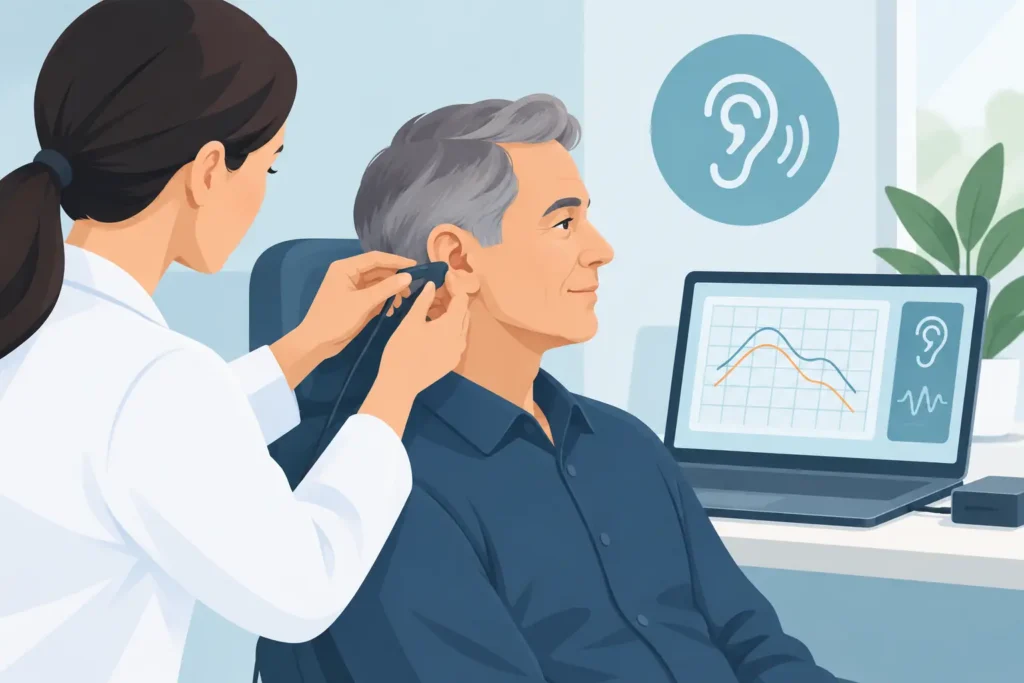
A hearing aid can have excellent technology, but it still needs to be adjusted for the ear that will wear it. Patients often ask, “How does real ear measurement work?” The answer is simple: it measures the sound a hearing aid actually delivers inside your ear canal, then helps your audiologist fine-tune the settings to match your hearing needs.
This is one of the most valuable steps in a hearing aid fitting. It moves care beyond general software estimates and gives your audiologist objective information about your personal ear shape, hearing loss, and amplification needs.
How Does Real Ear Measurement Work?
Real ear measurement, sometimes called REM or probe microphone measurement, is a verification test performed while you are wearing your hearing aid. A registered audiologist places a very thin, flexible probe tube in your ear canal, usually alongside the hearing aid. The tube is connected to specialized equipment that measures sound levels close to your eardrum.
The tube does not deliver a shock or cause pain. It is simply a microphone placed at a carefully measured depth in the ear canal. You may feel a slight tickle or awareness of the tube, but most patients find the procedure comfortable and straightforward.
Once the probe tube and hearing aid are in place, a speaker positioned in front of you plays calibrated speech-like sounds. The equipment records how much sound reaches your ear across low, middle, and high pitches. Your audiologist compares these results with evidence-based prescription targets calculated from your hearing evaluation.
If the hearing aid is providing too little amplification in certain frequencies, soft speech may remain unclear. If it is providing too much, sound may be uncomfortable or overly sharp. The audiologist can adjust the hearing aid settings and repeat the measurement until the output more closely meets your prescribed targets.
Why Software Predictions Are Not Enough
Hearing aid programming software starts with your audiogram and uses a fitting formula to suggest initial settings. This is useful, but it is still a prediction. It cannot fully account for the shape and length of your ear canal, the way the hearing aid sits in your ear, or the acoustics created by earmolds, domes, vents, and receiver size.
Two people can have similar hearing test results yet require different adjustments. One person may have a narrow or curved ear canal. Another may use an open dome that allows more natural low-frequency sound to enter the ear. Wax, ear anatomy, and the position of the hearing aid can also affect the sound reaching the eardrum.
Real ear measurement checks the result rather than assuming the initial settings are correct. It is the difference between selecting a setting that should work on paper and verifying that it works in your ear.
What Your Audiologist Measures
The testing process commonly begins by measuring the natural resonance of your open ear. Every ear canal naturally changes the level of sound that enters it, particularly in the frequencies most important for speech understanding. This baseline helps the audiologist understand your individual ear acoustics.
Next, the hearing aid is measured while it is turned on. Speech-like signals are played at different volumes, often including soft, average, and loud inputs. This matters because a hearing aid should not simply make everything louder. It should provide enough support for quiet conversation while keeping louder sounds within a comfortable range.
The audiologist reviews a graph that shows the hearing aid’s measured output compared with your prescribed targets. Adjustments may involve gain at specific pitches, maximum output, noise-management settings, or the balance between the two ears when you wear hearing aids on both sides.
For many adults, the goal is improved access to speech sounds, including higher-pitched consonants such as s, f, th, sh, and ch. These sounds often contribute greatly to speech clarity but are commonly affected by hearing loss. Real ear measurement helps determine whether the hearing aid is providing appropriate access to them without making the overall sound harsh.
What Happens During a Real Ear Measurement Appointment
Your appointment begins with a review of your hearing test, communication concerns, and the situations where you want more support. You may talk about conversations at home, restaurants, meetings, religious services, phone calls, television, or time with grandchildren. These details help guide the fitting and subsequent counseling.
Your ears will be checked with an otoscope before testing. Significant earwax, drainage, irritation, or an ear infection may need to be addressed before accurate measurements can be completed.
During the measurement, you will sit still and face the speaker. You do not need to repeat words or respond to the sounds. The equipment is measuring sound levels, not testing your ability to hear. Your audiologist will explain what is happening, make programming adjustments as needed, and may repeat the test more than once.
After the verification is complete, there is still room for your input. Real ear measurement provides objective data, while your listening experience remains essential. If your own voice sounds unusual, dishes seem too loud, or a particular environment remains difficult, those concerns should be discussed. Some changes require a brief adjustment period, while others may call for further fine-tuning.
Is Real Ear Measurement the Same as a Hearing Test?
No. A hearing test identifies the softest sounds you can hear at different pitches and helps determine the type and degree of hearing loss. Real ear measurement verifies the sound delivered by a hearing aid in your ear.
Both are important, but they answer different questions. The hearing test helps establish what amplification may be appropriate. Real ear measurement checks whether the fitted device is delivering that amplification accurately.
Speech testing, questionnaires, and real-world follow-up also add useful information. Hearing care is not a one-time device purchase. It is an ongoing clinical process that includes verification, education, adjustment, and support as your needs change.
Why Verification Matters for Comfort and Clarity
A hearing aid can be physically comfortable yet acoustically underfit, meaning it does not provide enough amplification to support speech understanding. This can happen when settings are kept too low because the wearer is concerned about loudness, or when a default fitting is accepted without verification.
On the other hand, excessive output can make sound tiring or unpleasant. Accurate fitting is especially important for people with sensitivity to loud sounds, tinnitus, a long period of untreated hearing loss, or complex listening demands.
Real ear measurement does not guarantee that every sound will immediately feel natural. The brain may need time to adapt to hearing sounds it has not heard clearly for years. However, verified settings give you a reliable clinical starting point. They support a more informed conversation about what is adjustment, what is preference, and what needs to be changed.
Does Everyone Need Real Ear Measurement?
In most hearing aid fittings, real ear measurement is strongly recommended because it provides individualized verification. It can be particularly valuable for first-time hearing aid users, people with more complex hearing losses, those who have struggled with previous devices, and people using custom earmolds or specialty hearing aid styles.
There are occasional situations where a standard probe-tube measurement may not be practical, such as an ear canal that is unusually narrow, sensitive, or medically restricted. In these cases, an audiologist may use alternative verification approaches and document why they are appropriate. The best method depends on ear health, anatomy, hearing needs, and the device being fitted.
For children, verification is especially important because access to speech sounds supports communication and language development. Pediatric methods may differ based on age, cooperation, and ear anatomy, but the principle is the same: the hearing technology should be checked against the child’s individual needs.
Questions to Ask at Your Hearing Aid Fitting
You are entitled to understand how your hearing aids are being fitted and verified. Ask whether real ear measurement will be completed, how closely the settings match your prescription, and what adjustments are being made for your listening goals. It is also reasonable to ask what follow-up care is available if the devices do not feel right in daily life.
At Golden Hearing & Balance Center, a Doctor of Audiology-led fitting is designed to include both clinical verification and attentive discussion. The goal is not simply to make sound louder. It is to help you hear more comfortably and communicate with greater confidence in the situations that matter to you.
If you are considering hearing aids or questioning whether your current devices are programmed appropriately, a comprehensive hearing evaluation and verified fitting can offer useful clarity. The right next step is a conversation with an audiologist who will measure carefully, explain the results plainly, and continue to listen after the appointment.