In my clinic here in Woodbridge, the most common question I receive from concerned patients and their families is: “Are AI hearing aids really different from older technology, or are they just glorified amplifiers?” It is a valid, logical question. For decades, traditional hearing technology simply turned up the volume on everything. If you were in a quiet room, it worked. If you were at a busy restaurant in Vaughan, the experience was often overwhelming.
Is modern technology just a glorified amplifier?
No.
As a Doctor of Audiology, Audiologist, Reg. CASLPO, I can tell you that the landscape of hearing healthcare has undergone a paradigm shift, moving away from simple linear amplification toward Deep Neural Network (DNN) Artificial Intelligence.
1. The Bionic Bridge: Processing Sound Like the Human Brain
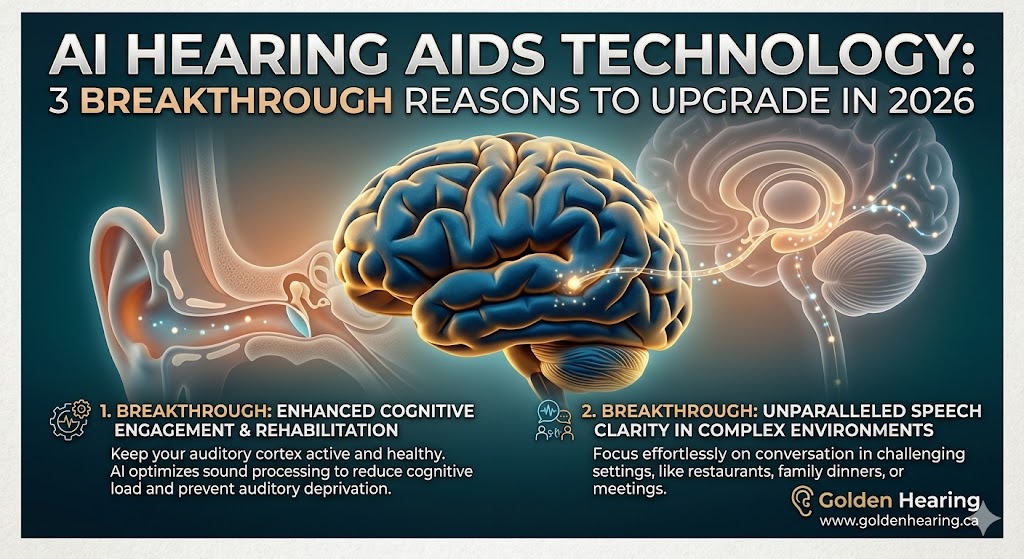
Modern technology, specifically high-end platforms like the Beltone Envision 17 and the Phonak Infinio Sphere, acts less like a standard speaker and more like a “bionic bridge” for your brain. In modern clinical practice, we no longer just “fix ears”; we support the entire auditory cortex.
These advanced AI hearing aids are programmed with millions of real-world sound samples. They don’t just sit in your ear; they actively analyze your acoustic environment hundreds of times per second. By identifying the difference between a friend’s voice and the background clatter of a busy café, the AI suppresses environmental noise and prioritizes the specific speech frequencies that matter to you. This level of precision allows for effortless listening, even in the most challenging environments.
2. Clinical Rehabilitation and Cognitive Health
As a clinician, I often remind patients that we hear with our brains, not just our ears. When hearing loss is left untreated, the auditory pathways in the brain can lose their ability to process complex sounds—a phenomenon known as auditory deprivation.
By adopting AI-driven technology early in 2026, we are doing more than just improving volume; we are engaging in auditory rehabilitation. We are keeping the neural pathways between your ears and your brain active and healthy. This is essential for long-term cognitive health, as research consistently links untreated hearing loss to an increased risk of cognitive decline and dementia. AI helps bridge this gap by providing a clearer, more natural signal that requires less “mental effort” to understand.
3. Future-Proof Connectivity: The Power of Auracast
A major breakthrough for 2026 is the mainstream adoption of Auracast™ broadcast audio. This technology is a game-changer for accessibility in public spaces. Unlike traditional Bluetooth, Auracast allows you to “tune in” to high-quality audio streams in airports, theaters, and lecture halls directly through your hearing aids.
Combined with seamless smartphone integration, modern aids are essentially high-performance wireless earbuds designed for the hearing impaired. Whether you are streaming a phone call or listening to a presentation at a Vaughan community center, the clarity is studio-quality, removing the barriers that once made public social settings stressful.
The Gold Standard: Real-Ear Measurement (REM)
While the technology is impressive, the “magic” isn’t just in the box—it’s in the calibration. At Golden Hearing & Balance Center, we believe that every auditory profile and every ear canal is unique.
A major differentiator of our clinical approach is our commitment to Real-Ear Measurement (REM). This is a clinical procedure where we use a tiny probe microphone to measure exactly how the hearing aid is performing inside your specific ear canal. Without REM, an audiologist is simply guessing based on computer averages and manufacturer presets. With it, we ensure that your 2026 AI technology is mathematically optimized for your unique physical anatomy. This ensures that the softest sounds are audible and the loudest sounds are comfortable.
Your Path to Better Hearing in Vaughan & Woodbridge
If you are struggling in complex environments, you don’t need a “one-size-fits-all” device. You need a diagnostic fitting. At our clinic, we use precise clinical data to match specific technology—whether it’s Phonak, Starkey, or Beltone—to your life’s specific demands.
The goal isn’t just to hear louder; it’s to hear better, feel less tired, and stay connected to the people who matter most. Your hearing health is a critical component of your overall wellness and quality of life.
About the Author: Masoud Bagherian, Au.D. is a Doctor of Audiology, Audiologist, Reg. CASLPO and the founder of Golden Hearing & Balance Center in Woodbridge, Ontario. With over 27 years of international clinical experience, he specializes in advanced vestibular diagnostics and AI-integrated hearing solutions.
[Call to Action Button: Schedule a Diagnostic Consultation at our Woodbridge Clinic] www.goldenhearing.ca